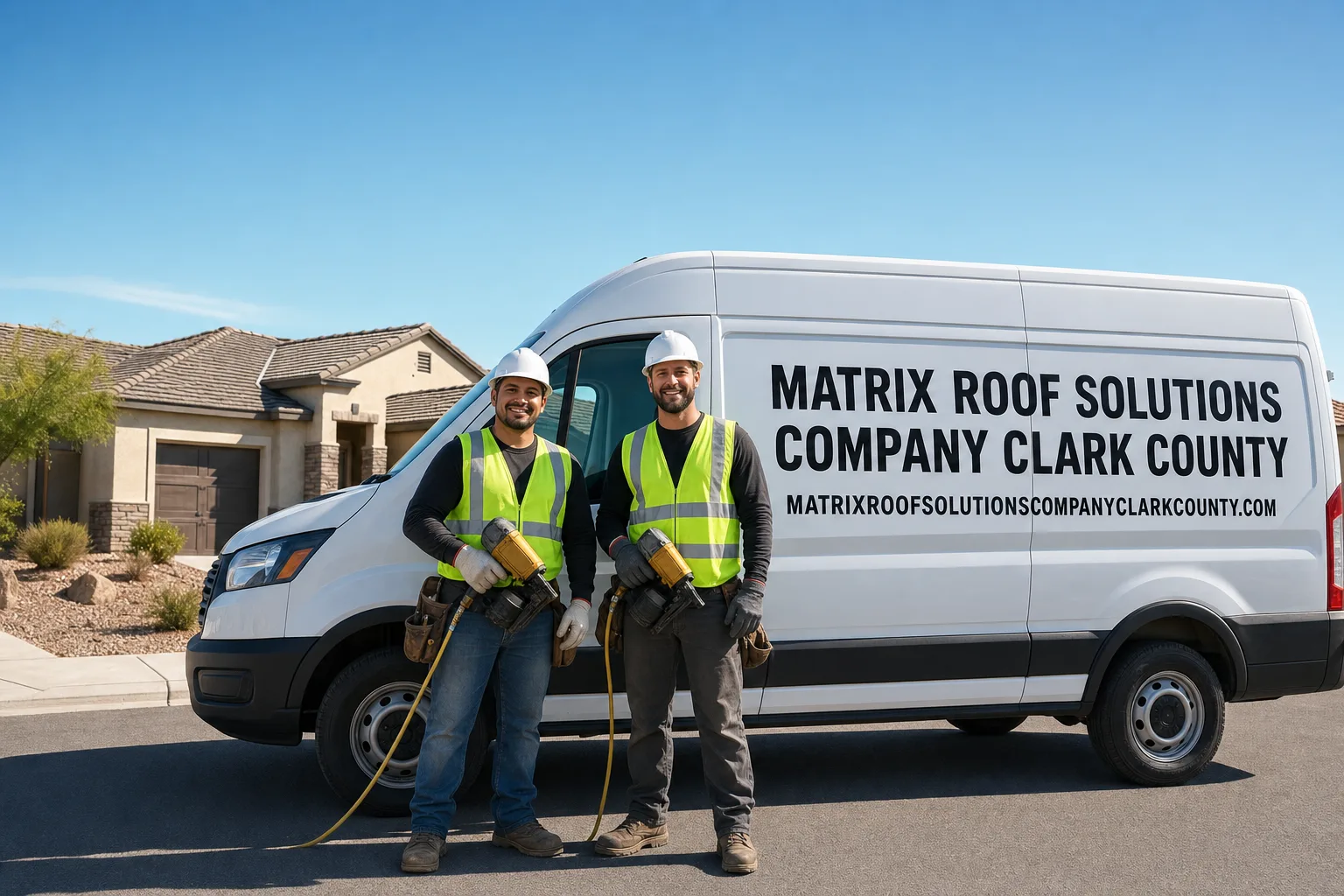
Fast, Reliable Specialty Roofing Across North Las Vegas
If you own a flat or low-slope roof in North Las Vegas — and there are tens of thousands of them, most pushing 50 to 70 years old — you’re dealing with a roofing environment that punishes generic solutions. Our Specialty Roofing team at Matrix Roof Solutions Company Clark County understands the specific failure modes that North Las Vegas’s open desert exposure, extreme heat island, and Clark County code requirements create. Emmet Boyd, Owner and Lead Technician, personally oversees every assessment and installation. Call us at (725) 266-8694 for a free, no-obligation estimate.
Why Matrix Roof Solutions Company Clark County Is North Las Vegas’s Preferred Specialty Roofing Company
We’ve built our reputation street by street across North Las Vegas — from the post-WWII flat-roof neighborhoods near the older city core out to the newer concrete-tile tracts in Craig Ranch. Over 106 homeowners have reviewed our work and given us a 4.8-star average. That’s not a lucky streak — it’s what happens when the owner, Emmet Boyd, is the same person on the ladder assessing your deck, not a project manager forwarding photos from an office. Emmet brings 16 years of hands-on roofing experience to every North Las Vegas job, which means he’s seen the Clark County layer-count enforcement issue, the monsoon ponding failure mode, and the 170°F surface temperature problem dozens of times. You’re not explaining your situation to someone learning on the fly.
Our Specialty Roofing Services in North Las Vegas
Modified Bitumen Roofing
Modified bitumen is the workhorse solution for the post-WWII flat-roof housing stock that dominates North Las Vegas’s older city core and Bonanza Village corridor. The material’s reinforced SBS or APP polymer layers hold up to the thermal cycling that swings from 170°F rooftop surfaces in July to freezing overnight temperatures in January — a range that cracks standard built-up membranes at mid-field rather than at seams. When our crew corded a 1960s single-story on the east side of Bonanza Village after a July monsoon surge left standing water across a three-square section of original tar-and-gravel roofing, we found four accumulated layers — one past the Clark County maximum for a permitted overlay. We executed a full tear-off, applied a modified bitumen cap sheet over tapered ISO board to correct the drainage pitch, and completed the project with a City of North Las Vegas building inspection sign-off before the next storm window opened. That’s the kind of scope most out-of-area contractors never price for.

TPO Roofing
TPO single-ply membranes are increasingly popular on North Las Vegas commercial and residential flat roofs because their reflective white surface meaningfully cuts heat absorption — a real advantage when rooftop temperatures regularly exceed 170°F along the city’s industrial corridors near South Commerce Street. The critical issue we see here is heat-accelerated seam failure: North Las Vegas’s sustained high temperatures collapse TPO lap-joint adhesion years ahead of what manufacturer projections assume, creating open seams that let monsoon water in before you see any sign of trouble from the ground. We account for this by specifying higher weld temperatures and wider seam widths during installation, and we use TPO membranes from manufacturers whose formulations are tested against Southwest desert conditions.

EPDM Roofing
EPDM rubber membranes perform well on North Las Vegas low-slope roofs when installed with proper ballasting or full-adhesion systems — the membrane’s inherent flexibility handles thermal expansion without cracking, which matters when your roof swings 80 degrees between summer afternoon and winter night. The failure mode we correct most often on existing EPDM installations in North Las Vegas is inadequate drainage design: the original 1950s–1970s roof decks in ZIP codes like 89106 were never pitched for modern membrane drainage expectations, so ponding water sits on the field of the membrane and exploits any seam weakness during the July–August monsoon. Proper tapered insulation installation at re-roof time is the fix, not another coat of sealant.

Solar-Ready Roofing
With Nevada’s net metering program and North Las Vegas’s 300-plus sunny days per year, solar panel installations are accelerating across the city — and the roofing underneath has to be prepared to carry that load for 25 or more years without a disruptive re-roof mid-panel-life. We install solar-ready underlayment systems and reinforced membrane platforms, particularly on the newer master-planned areas like Craig Ranch where tile roofs are being retrofitted, and on flat commercial-style roofs where ballasted panel mounts interact directly with the membrane. Getting the roof right before the panels go on is far less expensive than removing an array to replace a failed membrane five years later.

What happens when you call
- 1
A real person answersNo phone trees — you reach a local pro.
- 2
You get an upfront price rangeHonest numbers before anyone is dispatched.
- 3
A background-checked tech heads outLicensed & insured, dispatched right away.
- 4
You approve before work beginsNothing starts until you say go.
Trusted Brands We Service in North Las Vegas
Matrix Roof Solutions Company works with material lines from GAF, CertainTeed, Tamko, and Boral, among others — seven manufacturers total. For North Las Vegas specialty roofing projects, that breadth of product access matters: different flat-roof assemblies call for different membrane systems, and we’re not limited to steering you toward the one line a single-brand dealer stocks. We specify materials matched to North Las Vegas’s actual climate and load conditions, not manufacturer marketing assumptions written for milder markets. Fast local sourcing keeps projects on schedule, which is especially important when you’re racing a monsoon forecast.
Common Specialty Roofing Problems We See in North Las Vegas Homes
- SPF foam delamination from unobstructed desert winds: The flat northern valley geography funnels strong prevailing winds across Bonanza Village and the older city core at speeds that strip SPF foam coatings from low-slope roofs. Delamination and blow-off occur here at wind speeds that leave more sheltered roofs in the southern valley untouched — meaning foam-coated flat roofs in North Las Vegas need more frequent inspections than the same product elsewhere in the metro.
- Monsoon ponding on under-pitched original decks: Short-duration July–August monsoon downpours overwhelm the inadequate slope of 1950s–1970s flat-roof decks, causing rapid ponding that hydrostatic-stresses aged modified bitumen and built-up membranes until they blister and crack at mid-field. Many homes along West Charleston Boulevard and in the 89106 ZIP code are on original decks that were never designed to drain this volume of water in this short a window.
- TPO and EPDM seam failure from heat island temperatures: Rooftop surface temperatures above 170°F along North Las Vegas’s industrial corridors accelerate the adhesion breakdown of single-ply lap joints well ahead of manufacturer timelines. By the time the failure is visible from the ground — water staining on the ceiling — the open seam has typically been admitting moisture through multiple monsoon cycles.
- Mandatory full tear-offs triggered by Clark County’s layer-count limit: The Clark County building department enforces a maximum number of re-roof layers, and many older North Las Vegas flat roofs have had multiple built-up systems applied over decades. Inspectors routinely flag these properties when a new permit is pulled, requiring a full tear-off before any new specialty membrane can be permitted. This is a hidden scope addition that surprises both homeowners and out-of-area contractors who bid the job as a simple overlay.
Pricing for Specialty Roofing in North Las Vegas, NV
Specialty roofing costs in North Las Vegas vary based on roof size, system type, and — critically here — whether Clark County requires a full tear-off before a new membrane can be permitted. A basic TPO or EPDM installation on a straightforward flat roof in North Las Vegas typically runs $5.50–$8.50 per square foot installed. Modified bitumen systems on the post-WWII housing stock, which frequently require tear-off of multiple accumulated layers, generally run $6.00–$10.00 per square foot, with the mandatory tear-off adding $1.50–$2.50 per square foot in labor and disposal. Solar-ready roofing platforms start around $7.00–$12.00 per square foot depending on reinforcement specifications. Call (725) 266-8694 for a free on-site estimate — Emmet Boyd will assess your specific deck and give you an honest number before any work is scheduled.
We Also Serve Cities Near North Las Vegas
Our specialty roofing work extends across the broader valley, including Sunrise Manor, areas adjacent to Nellis Air Force Base, and Las Vegas proper. If you’re just outside North Las Vegas city limits, call us — if we can reach your roof, we’ll assess it. Every job gets the same direct oversight from Emmet Boyd regardless of which side of the city line you’re on.
Serving North Las Vegas, NV — Our Local Coverage Area
We’re based in the North Las Vegas area and know this community well. Use the map below to see our service coverage — if you’re nearby, we can almost certainly help.
FAQs — Specialty Roofing in North Las Vegas
Clark County enforces a strict limit on the number of roofing layers allowed on any structure, and many older North Las Vegas flat roofs — especially in the Bonanza Village corridor and the older city core — have had multiple built-up systems applied over decades without any previous tear-off. When you pull a permit for a new specialty membrane, the city inspector reviews the existing assembly; if the layer count is at or over the maximum, a full tear-off is legally required before any new system can be installed. This isn’t negotiable, and it’s a scope addition that can catch both homeowners and out-of-area contractors completely off guard. We core-sample the existing assembly before we price any North Las Vegas flat-roof job so there are no surprises mid-project. Call (725) 266-8694 to schedule an honest assessment.
A properly installed specialty membrane — modified bitumen, TPO, or EPDM — is adhered or mechanically fastened as a continuous field across the deck, with no individual tabs or edges for wind to get underneath. Standard shingles on a flat or near-flat deck are particularly vulnerable because the reduced pitch means wind approaches the surface at a much flatter angle, generating uplift across the entire tab rather than a narrow leading edge. North Las Vegas’s open northern valley position amplifies this: wind loads in the Bonanza Village and East Lake Mead corridor regularly exceed those recorded in the more sheltered southern valley. A continuous-adhered modified bitumen or fully-welded TPO system eliminates the tab edge entirely and dramatically outperforms shingles on low-slope geometry. Call us at (725) 266-8694 and we’ll assess what your deck actually needs.
In North Las Vegas, plan on a recoat cycle of 5–7 years, not the 10-plus years you’ll see in most product literature. SPF coating manufacturers develop their service-life projections using UV exposure and temperature data from a broad range of climates; North Las Vegas’s roughly 300 sunny days per year, combined with rooftop surface temperatures that regularly exceed 170°F in summer, degrades elastomeric topcoats significantly faster than those baseline assumptions account for. The unobstructed desert exposure on the northern valley also means wind-driven sand and particulate matter abrade the coating surface, further compressing the protective life. If your SPF roof is approaching five years without a recoat inspection, schedule one before monsoon season arrives. Call (725) 266-8694 for a free condition assessment.
Modified bitumen is a reinforced asphalt membrane — typically polyester or fiberglass mat saturated with polymer-modified asphalt — that’s installed in one or two plies over insulation or a prepared deck surface. It’s the recommended system for North Las Vegas’s post-WWII flat-roof housing stock for a few specific reasons: it tolerates the extreme thermal cycling that swings from 170°F summer surfaces to near-freezing winter nights without cracking, it can be applied in sections that match the geometry of older irregular deck configurations, and it’s durable enough to handle the hydrostatic stress that monsoon ponding puts on mid-field membrane areas. It’s also well within the installation repertoire of local North Las Vegas building inspectors, so permit and inspection processes are straightforward. If you’re in the 89106 or 89102 ZIP code and your flat roof is original or first-generation replacement, modified bitumen is almost certainly the conversation we’ll be having. Call (725) 266-8694 to confirm.
Specialty roofing absolutely applies to Craig Ranch concrete tile homes — just in a different way than it does for flat-roof properties. The specialty element on tile roofs is typically the underlayment system beneath the tile, which bears the actual waterproofing load. Tile is a surface layer; if the underlayment beneath it has failed — which happens faster in North Las Vegas’s UV and heat environment than manufacturers typically project — you’ll see leak damage even when the tile itself looks perfect from the street. We also install solar-ready membrane platforms on Craig Ranch roofs as part of pre-panel preparation. CertainTeed and GAF both offer underlayment systems rated for desert Southwest conditions that we specify on these projects. Call (725) 266-8694 and Emmet Boyd will assess your underlayment condition directly — not through a junior rep’s checklist.
Written by Emmet Boyd, Owner and Lead Technician at Matrix Roof Solutions Company Clark County, serving North Las Vegas since 2009.