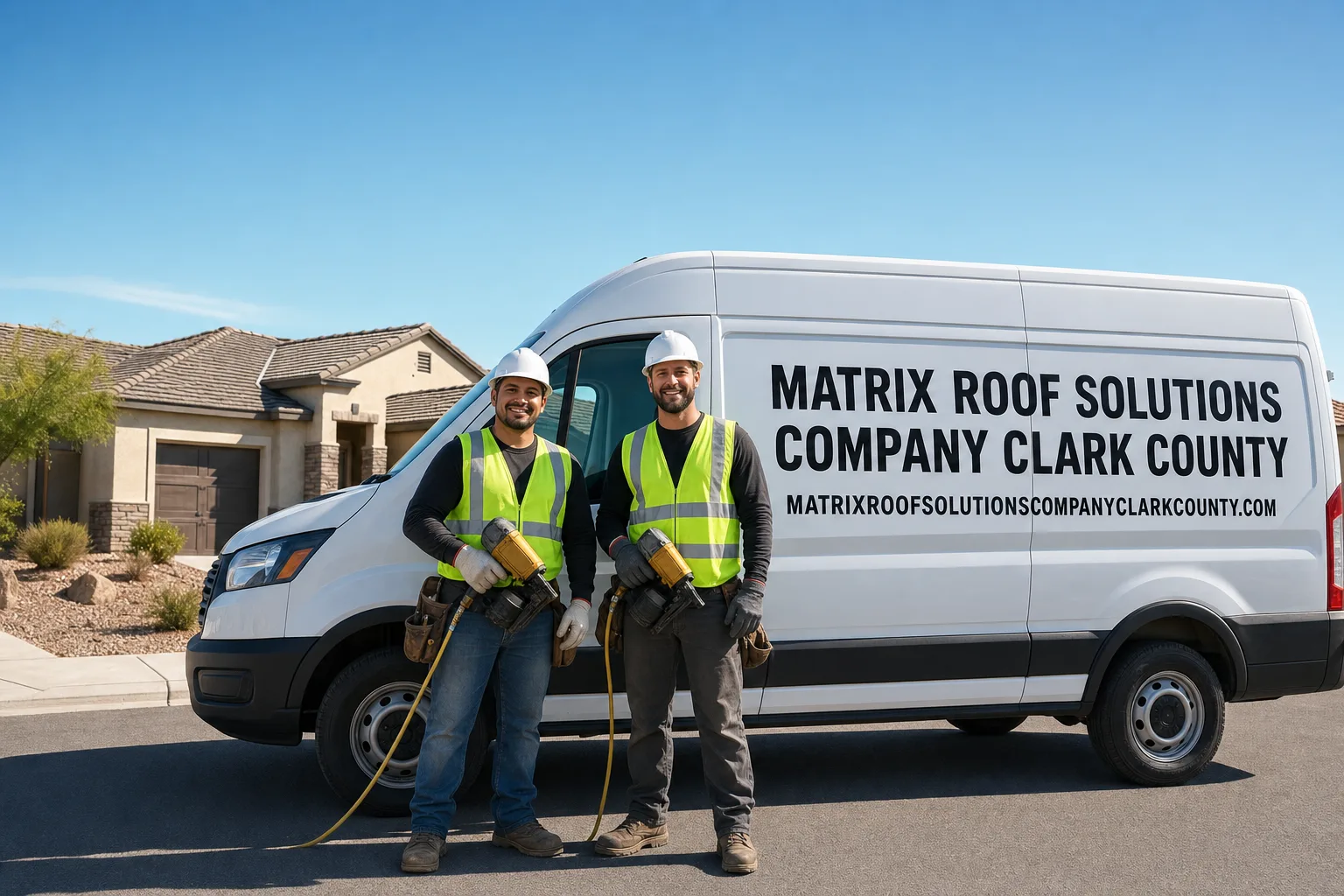
Fast, Reliable Roof Repair Across Las Vegas
Roof repair in Las Vegas, NV typically runs $350–$1,800 depending on the damage type, roofing system, and materials involved — and because flat-roof and tile systems dominate the valley’s housing stock, the diagnostic work here is fundamentally different from anywhere else in the country. If you’re seeing water intrusion after a monsoon surge or noticing cracked tile after a high-wind event, the clock matters. Call our Roof Repair team at (725) 266-8694 for a free estimate — we respond quickly to jobs across Las Vegas and the surrounding Clark County area.
Why Matrix Roof Solutions Company Clark County Is Las Vegas’s Preferred Roof Repair Company
Emmet Boyd has spent 16 years on actual roofs — not managing paperwork from an office — and that direct, hands-on experience matters especially in Las Vegas, where the roofing systems, failure modes, and code requirements are genuinely unlike what contractors face in most U.S. cities. When Emmet shows up for your assessment, you’re getting the person whose name is on the business, not a subcontracted crew making decisions they can’t stand behind. That accountability shows up in the numbers: 106 verified reviews averaging 4.8 out of 5 stars — consistency that only comes from doing the same job right, repeatedly, across hundreds of Las Vegas homes. From flat-roof stucco ranches near East Charleston Boulevard to Mediterranean tile tracts closer to the 89169 ZIP code, we’ve worked on the full range of what Las Vegas’s housing stock throws at us, and we know the Clark County permit and inspection process well enough to get your repair signed off without surprises.
Our Roof Repair Services in Las Vegas
Flashing Repair
Flashing is the single most common entry point for water in Las Vegas homes — not because the flashing is cheap, but because the extreme thermal cycling here (40°F nights to 110°F+ summer afternoons) contracts and expands metal and sealant far faster than in moderate climates, breaking adhesive bonds within just a few seasons. We see this constantly on parapet walls and penetration flashings across flat-roof properties near West Flamingo Road and in the Twin Lakes area. Any flashing repair we perform is reinstated to Clark County’s 90-mph wind-uplift standard — which means the anchoring pattern, fastener spacing, and counterflashing seal all meet the rated assembly spec, not just a cosmetic patch that looks right but fails the next permit inspection.

Flat Roof Patch
Las Vegas’s residential housing stock — particularly the 1950s–1970s stucco ranch homes concentrated in ZIP codes like 89101 through 89108 — is almost entirely flat or low-slope, which means flat-roof patching is one of the most common calls we get. The problem with patching a flat roof here isn’t finding the leak; it’s diagnosing what’s underneath. Older homes in areas like The Pueblo often have two or three re-cover layers of modified bitumen or built-up roofing stacked on the original framing, and before we add any material, we check that the cumulative dead-load is still within what that lightweight 1960s wood framing can safely carry. When the substrate is solid, we install heat-welded torch-down cap sheet and clear the scupper so water moves off the roof before the next monsoon.

Leak Repair
Las Vegas averages under 4 inches of rain a year, which gives homeowners a false sense of security — until the August–September monsoon delivers two inches in two hours on a roof with a 1% slope and a partially clogged scupper. We’ve responded to post-monsoon calls in University Medical Center-area neighborhoods where standing water had already forced its way under modified bitumen lap seams within hours of a single storm. Leak repair here requires finding not just where the water entered, but why the drainage failed — and that usually means addressing flashing, scupper condition, and lap seam integrity at the same time.

Shingle Replacement
Asphalt shingles are less common in Las Vegas than in most U.S. cities, but they do appear on newer construction and additions across Sunrise Manor and some of the 89169 and 89170 zip code neighborhoods. When we replace shingles in Las Vegas, we spec products rated for the valley’s UV index and thermal stress — GAF and CertainTeed both offer lines designed for high-heat desert climates, and we’ll walk you through which product makes sense for your specific situation rather than defaulting to whatever’s cheapest at the supply house.

What happens when you call
- 1
A real person answersNo phone trees — you reach a local pro.
- 2
You get an upfront price rangeHonest numbers before anyone is dispatched.
- 3
A background-checked tech heads outLicensed & insured, dispatched right away.
- 4
You approve before work beginsNothing starts until you say go.
Trusted Brands We Service in Las Vegas
We’re authorized to install and repair roofing systems from seven major manufacturers, and for Las Vegas jobs we draw most frequently on GAF, CertainTeed, and Tamko — brands with strong desert-climate product lines and readily available materials through local Clark County distributors. That local supply chain matters: it means we’re not waiting on out-of-state shipments when you need a repair completed before the next monsoon window. Emmet Boyd selects materials based on your specific roof profile and what will actually hold up through Las Vegas’s thermal cycles, not based on margin.
Common Roof Repair Problems We See in Las Vegas Homes
- Clogged or undersized scuppers on flat roofs in Bonanza Village and Canyon Gate. Las Vegas’s minimal roof pitch offers zero gravity assist when a monsoon surge hits — scuppers that are partially blocked by debris or were undersized to begin with can’t move water fast enough, and standing water forces its way under modified bitumen laps within hours. Regular scupper clearing and oversizing during a repair visit can prevent an interior ceiling catastrophe from a single storm event.
- Cracked or slipped concrete and clay tile across Desert Shores and Buffalo Ranch tract homes. The tile itself is decorative — the felt or synthetic underlayment beneath it does the actual waterproofing work. A single cracked or displaced tile after a wind event exposes that underlayment directly to UV radiation, which degrades it within one full thermal season and causes interior leaks that can appear several feet from the original tile damage.
- SPF roofs in the 89102–89104 corridor that missed their elastomeric recoat window. Spray polyurethane foam roofs require an elastomeric topcoat reapplication every 5–7 years under Las Vegas’s UV index — skip one cycle and the foam oxidizes to a chalky, crumbling substrate that can’t be simply patched. A post-storm inspection on degraded SPF often converts what looks like a surface repair into a full section replacement. Catching it at the recoat stage is always the better outcome.
- Stacked re-cover layers on 1950s–60s framing in Charleston Heights. It was common practice for decades in older Las Vegas neighborhoods to apply new modified bitumen or BUR layers directly over existing ones rather than tear off — a cost-saving workaround that can now push cumulative dead-load beyond what the original lightweight wood framing was engineered to carry. Before adding any new roofing material to these homes, we assess the existing stack and flag any structural concern before the problem gets buried under another layer.
Pricing for Roof Repair in Las Vegas, NV
Here’s an honest look at what roof repair costs in the Las Vegas market:
- Flashing repair: $250–$600 per section, depending on material and linear footage
- Flat roof patch (modified bitumen or torch-down): $400–$1,200 per affected area
- Leak diagnosis and targeted repair: $350–$850, depending on how deep the source investigation goes
- Shingle replacement (partial section): $300–$900 depending on pitch, access, and material
- Vent boot repair or replacement: $150–$400 per boot
- SPF recoat (when caught in time): $1.50–$3.00 per square foot
What drives cost upward in Las Vegas specifically: multi-layer re-cover stacks that require dead-load assessment, scupper work combined with flashing repair, and SPF jobs that have passed the recoat window and require section removal. Emmet Boyd assesses every job in person before quoting — no estimates over the phone that balloon on arrival. Call (725) 266-8694 to schedule your free on-site estimate.
The Las Vegas Wind Code Every Homeowner Should Know About
Las Vegas sits in Clark County’s high-wind corridor, and the Southern Nevada Building Code enforces a 90-mph basic wind-speed design requirement for residential roofing systems. That number has direct consequences for repair work: tile fasteners, foam adhesive patterns, and flashing anchors must all meet specific uplift-resistance specifications that exceed the standard used in most other inland Western cities. This isn’t bureaucratic fine print — it’s structural reality. Any repair that disturbs the original tile-set or flashing without reinstating the rated fastening pattern can void the assembly’s wind classification. On the next permit pull, that can trigger a stop-work order. We know the Clark County spec, we carry the right fasteners, and we document the work so you’re not left holding an improperly reinstated assembly that fails inspection or, worse, fails in the next high-wind event.
Our crew responded to a post-monsoon call in Charleston Heights where a 1960s flat-roof stucco ranch on West Flamingo Road had lost two linear sections of modified bitumen lap seaming along the parapet flashing. The 40°F overnight-to-110°F daytime thermal swing had finally cracked the aged cold-process adhesive, and the August downpour drove water straight into the interior ceiling. We stripped the failed laps back to solid substrate, confirmed the underlying BUR layers were within allowable dead-load limits for the original light-frame framing, then installed a heat-welded torch-down cap sheet with new galvanized counterflashing sealed to the parapet wall, leaving the scupper clear and draining true before we signed off. That kind of sequenced repair — substrate assessment, dead-load check, code-compliant installation, drainage verification — is what separates a durable fix from a patch that holds until the next monsoon.
We Also Serve Cities Near Las Vegas
Matrix Roof Solutions Company Clark County serves homeowners and property owners throughout the broader valley. In addition to Las Vegas, we regularly work in North Las Vegas (our primary base of operations), Sunrise Manor, and areas surrounding Nellis Air Force Base. If you’re within Clark County and dealing with a roof problem, we can get Emmet Boyd on-site for a proper assessment — call (725) 266-8694 to confirm scheduling for your area.
Serving Las Vegas, NV — Our Local Coverage Area
We’re based in the Las Vegas area and know this community well. Use the map below to see our service coverage — if you’re nearby, we can almost certainly help.
FAQs — Roof Repair in Las Vegas
Yes — in most cases, disturbing or replacing flashing and re-fastening lifted tiles on a permitted structure in Las Vegas requires a Clark County roofing permit, particularly when the repair involves modifying the original wind-rated assembly. The threshold isn’t always obvious: a cosmetic tile reset may not trigger a permit, but reinstalling counterflashing or altering the fastening pattern on a tile section typically does, because the Southern Nevada Building Code’s 90-mph wind-uplift requirement applies to the full assembly. We pull the permits we need and don’t cut corners to avoid the inspection process — that inspection is how you verify the repair was done correctly. Call (725) 266-8694 and we’ll tell you upfront what your specific repair will require.
Flat roofs in Las Vegas flood fast during monsoons because they were built with minimal slope — often less than 1/4 inch per foot — and their scuppers are frequently undersized for the volume a monsoon delivers in a short window. Las Vegas gets under 4 inches of rain annually, but the August–September monsoon can drop 1.5–2 inches in under two hours on a roof that offers no gravity assist whatsoever. Any debris in the scupper, any partial blockage in the drainage line, and water begins backing up immediately. Once it finds a lap seam or a cracked flashing joint, it’s inside your ceiling within hours. Regular scupper inspection and maintenance before monsoon season is the most cost-effective prevention available on these homes.
It depends on the dead-load condition of the existing stack, and that’s not something we can answer without getting on the roof. Patching the top layer is sometimes a legitimate repair — but only if the cumulative weight of the existing layers is still within the load capacity of your original framing. Older Las Vegas homes in areas like Charleston Heights were frequently built with lightweight 1950s–60s wood framing that wasn’t engineered to carry more than a specific dead-load. If the stack is already at or near that limit, adding another layer — even a patch — creates a structural problem that can’t be ignored. Emmet Boyd checks the existing stack before recommending any repair approach. Call (725) 266-8694 to get an honest on-site assessment.
Faster than most homeowners expect — typically within one full thermal season if the underlayment beneath the tile is already aged. Concrete and clay tiles are decorative; the felt or synthetic underlayment does the waterproofing. When a tile cracks or slips after a wind event, that underlayment is exposed directly to Las Vegas’s intense UV radiation. A single summer of direct UV exposure is enough to degrade aged felt to the point where the next monsoon rain drives straight through it — and because water travels along rafters and sheathing before dripping, the interior leak often appears nowhere near the damaged tile. Don’t assume a cracked tile is cosmetic. Get it looked at before monsoon season, not after.
Repaired roof sections in Las Vegas should be reinstated to meet Clark County’s 90-mph basic wind-speed design requirement — the same standard the original assembly was built to. For tile roofs, that means the fastening pattern, number of fasteners per tile, and any foam adhesive application must match the rated assembly spec. For flashing and membrane work, it means the anchor spacing, counterflashing embedment, and sealant type all meet uplift-resistance values. Verification comes from the Clark County building inspection on permitted work — the inspector signs off that the assembly meets code. We document every repair with photographs and material specs so you have a record even for minor work that falls below the permit threshold. Call (725) 266-8694 and we’ll explain exactly what your repair will require and how the work will be documented.
Schedule Your Free Roof Repair Estimate in Las Vegas
If you’re dealing with a leak, damaged tile, failed flashing, or a flat roof that didn’t survive the last monsoon, the next step is a real on-site assessment — not a ballpark over the phone. Emmet Boyd, Owner and Lead Technician at Matrix Roof Solutions Company Clark County, personally evaluates every Las Vegas job before any work is quoted or started. Sixteen years of hands-on experience with the specific failure modes that define Las Vegas roofing means the diagnosis is informed, the repair is code-compliant, and the work is backed by an owner who shows up. Call (725) 266-8694 to schedule your free estimate — we serve the full Las Vegas valley including ZIP codes 89169, 89170, 89173, and 89177.
Written by Emmet Boyd, Owner and Lead Technician at Matrix Roof Solutions Company Clark County, serving Las Vegas, NV and the surrounding Clark County area for 16 years.