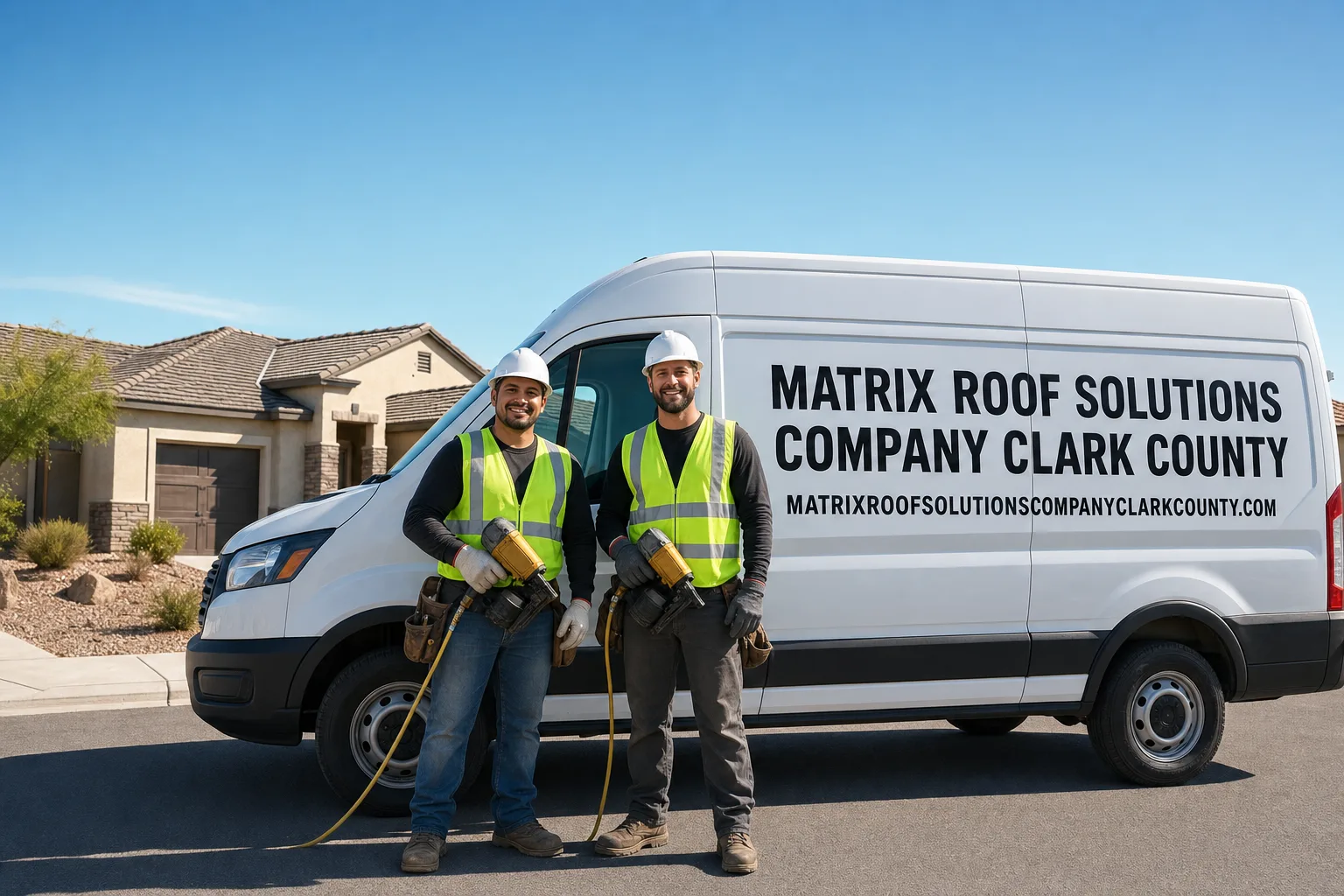
Fast, Reliable Emergency & Storm Damage Response Across Las Vegas
When a monsoon microburst rips through Las Vegas and water is already appearing on your ceiling, you don’t have time for voicemail loops or a subcontracted crew who’s never seen a flat-roof scupper in their life. Our Emergency & Storm Damage team responds directly to Las Vegas homes — with Emmet Boyd, Owner and Lead Technician, personally assessing damage and directing every repair. Call (725) 266-8694 now for an emergency response or a free damage inspection.
Why Matrix Roof Solutions Company Clark County Is Las Vegas’s Preferred Emergency & Storm Damage Company
Sixteen years in the roofing trade means Emmet Boyd has seen what Las Vegas storms actually do to the flat-roof and low-slope tile systems that define this city’s housing stock — and it’s fundamentally different from what a rain event does to a pitched shingle roof in Phoenix or Salt Lake. That specific, local diagnostic experience matters when you’re trying to figure out whether a field section of underlayment has separated behind intact-looking Boral or CertainTeed tile.
Over 106 verified customers have rated Matrix Roof Solutions 4.8 out of 5 stars — not a curated handful, but a consistent pattern built across Las Vegas, North Las Vegas, and surrounding Clark County communities. That kind of track record doesn’t happen by accident; it reflects showing up, doing the work correctly, and communicating clearly through every insurance claim and emergency call.
When storm damage can’t wait, neither do we. Our emergency response covers Las Vegas neighborhoods from West Las Vegas near North Jones Boulevard through Vegas Heights and the mid-century ranch corridors along West Cheyenne Avenue — areas where roof drainage geometry and housing age create failure modes that require experience, not guesswork.
Our Emergency & Storm Damage Services in Las Vegas
Wind Damage Repair
Las Vegas’s Clark County building code requires roofing systems in the 89101–89108 ZIP corridor to meet a minimum 90 mph wind-speed design pressure under ASCE 7. On the flat and low-slope tile roofs that dominate tract neighborhoods like Canyon Gate and Charleston Heights, that wind load is resisted entirely by the underlayment and flashing — not the tile or foam surface itself. A single failed flashing bond or loose scupper edge can allow an entire field section to peel back in a monsoon-season microburst even when the decorative tile surface looks completely undamaged from the street. We’ve seen it firsthand: our crew responded to a 1990s Mediterranean tile home in Canyon Gate after a microburst peeled a 14-foot section of synthetic underlayment away from the low-slope field adjacent to the parapet wall. The Boral concrete tiles were intact and still seated — which is exactly why the owner had no idea there was a problem until standing water appeared on the interior ceiling. We removed the displaced tile field, replaced the compromised self-adhered underlayment to current Clark County wind-load specifications, reseated and mechanically fastened the perimeter Boral tiles beyond the standard nail pattern, and documented every step for the insurance claim.

Storm Damage Repair
Las Vegas averages under 4 inches of rain annually, but the August–September monsoon season delivers sudden, high-intensity downpours on roofs built with minimal slope and drainage capacity. Clogged or improperly sloped scuppers on 1950s–1970s flat-roof ranch homes in Charleston Heights can convert a two-inch rainfall event into immediate interior flooding — especially when thermal cycling has already cracked flashing seams. In ZIP codes 89123 and 89124, we regularly see storm damage that looks minor on the surface but involves compromised penetration flashing and pooled water that has been sitting against a parapet for hours. We assess the full drainage picture, not just the visible tear.

Emergency Tarping
Standard emergency tarping assumes a pitched roof where a tarp can drape over a ridge and tension flat against the slope. Las Vegas roofs don’t work that way. On a flat or low-slope SPF system that has degraded past its recoat window, storm-driven wind can strip oxidized foam in irregular shards — creating voids that a standard tarp cannot seal flat against without additional mechanical attachment and edge flashing. Our emergency tarp installations in Las Vegas account for the actual roof geometry, ensuring water is directed to functional drains or scuppers rather than pooling against a failed seam overnight. A typical emergency tarp in Las Vegas runs $350–$650 depending on roof access, size of the compromised area, and whether secondary edge securing is required.

Insurance Claims Assistance
Las Vegas homeowners filing storm-damage claims face a specific challenge: adjusters unfamiliar with flat-roof and SPF systems often default to replacement cost models built around pitched shingle roofs, which don’t reflect actual local repair complexity or material costs. Emmet Boyd documents every job — photos of the failed underlayment, the peeled flashing, the scupper condition, the before-and-after of every repair sequence — in a format that supports your claim submission directly. We’ve worked through Clark County storm-damage claims across Vegas Heights, West Las Vegas, and the University Medical Center corridor, and we understand what documentation adjusters need to process a flat-roof or tile-roof loss accurately.

What happens when you call
- 1
A real person answersNo phone trees — you reach a local pro.
- 2
You get an upfront price rangeHonest numbers before anyone is dispatched.
- 3
A background-checked tech heads outLicensed & insured, dispatched right away.
- 4
You approve before work beginsNothing starts until you say go.
Trusted Brands We Service in Las Vegas
For underlayment systems, tile work, and repair membranes across Las Vegas, we work with manufacturers whose products are built for desert UV exposure and thermal cycling — including GAF, CertainTeed, and Boral. Boral’s concrete tile is widely installed across 1990s–2000s tract home communities in Las Vegas, and we carry compatible fasteners, flashing components, and self-adhered underlayment products to handle emergency repairs without waiting on special orders. For homeowners needing a full post-storm underlayment replacement, GAF’s high-temp modified underlayments are engineered specifically for the extreme UV and heat conditions Las Vegas roofs face.
Common Emergency & Storm Damage Problems We See in Las Vegas Homes
- Scupper failure on flat-roof ranch homes in Charleston Heights: These 1950s–1970s homes were built with minimal slope and drainage capacity. When scuppers clog with debris or the surrounding flashing cracks from 40°F+ daily thermal cycling, a single monsoon event can flood an interior ceiling within hours — not days.
- Degraded SPF foam stripping in Bonanza Village and surrounding areas: SPF roofs that have gone beyond their 5–7 year elastomeric recoat window oxidize to a brittle, chalky substrate. A monsoon-season wind gust doesn’t lift the membrane cleanly — it strips degraded foam in irregular shards, creating voids that require specialized patching, not standard emergency tarping.
- Underlayment separation behind intact tile on 1990s Mediterranean homes: The tile itself contributes almost nothing to waterproofing. In Canyon Gate and similar neighborhoods, we see intact-looking tile fields sitting over completely separated or torn synthetic underlayment — invisible from the ground, and obvious only when the ceiling stains appear. Post-storm inspections matter even when everything looks fine.
- Fastener pull-through on multi-layer re-cover roofs in older Las Vegas neighborhoods: Older Charleston Heights homes frequently have two or three re-cover layers of modified bitumen stacked on original 1950s lightweight wood framing — a cost-saving workaround that pushes dead-load beyond what that framing was engineered to carry. Storm-driven wind uplift on that heavy multi-layer assembly causes fastener pull-through rather than simple membrane separation, escalating what appears to be a surface repair into a structural issue that must be flagged before any new storm-repair system goes down.
Pricing for Emergency & Storm Damage in Las Vegas, NV
Flat and low-slope repairs in Las Vegas carry different cost structures than the pitched shingle repairs that most national pricing guides reference — so here are actual Las Vegas market ranges:
- Emergency tarping: $350–$650
- Flashing repair / scupper reseal (localized): $275–$550
- Underlayment replacement under tile field (per 100 sq. ft.): $400–$850, depending on tile removal complexity and underlayment spec
- SPF foam patch and recoat (storm-damaged section): $500–$1,200 depending on void size and substrate condition
- Wind damage repair — full field section (tile re-seat + underlayment): $900–$2,800 depending on square footage and Clark County permit requirements
- Insurance claim documentation package: Included with all storm-damage assessments
What drives cost in Las Vegas specifically: roof access (parapet height, rooftop HVAC equipment), whether Clark County requires a permitted repair versus a minor maintenance repair, the number of re-cover layers already on the deck, and whether the underlayment spec needs to be upgraded to meet current 90 mph wind-load design requirements. Call (725) 266-8694 — estimates are free, and Emmet Boyd will give you a straight number after the inspection, not a range that shifts at billing.
We Also Serve Cities Near Las Vegas
Matrix Roof Solutions Company Clark County serves Las Vegas and the surrounding communities of North Las Vegas, Sunrise Manor, and Nellis Air Force Base. Whether your storm damage is in a West Las Vegas neighborhood or near the Purple Heart Highway corridor in North Las Vegas, our response covers the full Clark County service area with the same owner-operated accountability on every call.
Serving Las Vegas, NV — Our Local Coverage Area
We’re based in the Las Vegas area and know this community well. Use the map below to see our service coverage — if you’re nearby, we can almost certainly help.
FAQs — Emergency & Storm Damage in Las Vegas
It depends on the scope of work, but for any repair that involves replacing underlayment, re-fastening tile, or modifying flashing on a permitted structure in the 89101–89108 corridor, Clark County typically does require a building permit — even for storm-damage repairs. Minor emergency tarping and temporary stabilization generally don’t trigger a permit requirement, but a full underlayment replacement under a tile field almost always does. We handle permit coordination on every qualifying job in Las Vegas, so the repair is documented and compliant — which also protects your insurance claim. Call (725) 266-8694 if you’re unsure whether your scope requires a permit; we’ll tell you honestly before work starts.
Yes — and this is the most important thing to understand about Las Vegas tile roofs. The tile itself does not waterproof your home; the underlayment beneath it does. Because Boral and CertainTeed concrete tiles can remain perfectly seated and visually intact while the synthetic underlayment underneath has separated, torn, or been displaced by wind uplift, the only way to assess actual storm damage is to get on the roof and probe the field. We’ve pulled intact tile from Canyon Gate homes and found 10–14 foot sections of underlayment completely detached from the low-slope field. The ceiling stain came weeks later. A post-storm inspection in Las Vegas is not optional for tile roofs — it’s how you catch a $600 underlayment repair before it becomes a $6,000 interior damage claim.
August and September in Las Vegas are a fundamentally different risk environment than the other ten months. The valley’s monsoon season delivers rapid, high-intensity downpours — sometimes 1–2 inches in under an hour — on roofs built with minimal drainage slope and often partially blocked scuppers. The same breach that sits dormant through a dry spring becomes an immediate interior flooding event during a monsoon storm. Emergency tarping urgency in Las Vegas during monsoon season is measured in hours, not days. If your roof was breached during a storm event between late July and mid-September, call (725) 266-8694 immediately — a second storm system can follow within 24–48 hours in the valley during peak monsoon weeks.
Coverage for an unmaintained SPF roof is one of the most contested claim categories in Las Vegas, and the answer depends on your specific policy language. Most standard homeowner’s policies cover sudden storm damage but exclude damage attributed to deferred maintenance — and an SPF system that has oxidized past its 5–7 year recoat window is routinely flagged by adjusters as a maintenance deficiency. That said, if storm-driven wind caused the damage event and the degraded foam was not the proximate cause, many claims are still recoverable with proper documentation. We photograph the substrate condition, the failure pattern, and the storm timeline to build the strongest possible submission. We can’t guarantee a claim outcome, but we can make sure the documentation tells the accurate story. Call (725) 266-8694 before the adjuster visits if possible.
Not without a structural assessment first — and we’ll tell you that directly rather than take the job and hand you a problem. Charleston Heights homes built in the 1950s–1970s frequently have two or three layers of modified bitumen or built-up roofing already stacked on lightweight wood framing that was engineered for a single-layer system. Adding storm-damage repair materials on top of that assembly without evaluating the dead-load math is a structural flag that Clark County code requires be addressed before new roofing goes down. In some cases, a full tear-off to the original deck is the only compliant path. Emmet Boyd will walk you through exactly what’s on the roof, what the structural picture looks like, and what your options are — including how to present a tear-off cost to your insurance adjuster when the existing system is already beyond safe load capacity. Call (725) 266-8694 for an honest, no-obligation assessment.
Get a Free Storm Damage Assessment in Las Vegas Today
If your Las Vegas home has been hit by a monsoon storm, high winds, or any sudden weather event, don’t wait for ceiling stains to appear before calling. The underlayment and flashing failures that define Las Vegas storm damage are invisible from the ground — and they get worse with every thermal cycle. Emmet Boyd, Owner and Lead Technician at Matrix Roof Solutions Company Clark County, will personally assess your roof, document the damage, and give you a straight answer on what the repair requires and what it will cost.
Call (725) 266-8694 now for a free inspection and emergency response in Las Vegas. We serve ZIP codes 89123, 89124, 89125, and 89126, along with the full Clark County service area including North Las Vegas and Sunrise Manor.
Written by Emmet Boyd, Owner and Lead Technician at Matrix Roof Solutions Company Clark County, serving Las Vegas since 2009.